





Tired of Being Dismissed at IEP or 504 Plan Meetings?

You're not alone. And you're about to feel a whole lot more prepared. Get professional IEP and 504 plan advocacy letters, video training, and tools, all created by a former social worker with over a decade of public school experience.

  • Learn everything about IEPs and 504 plans with our complete video course so you understand the system and know your rights under IDEA
  • Create professional advocacy letters with our guided letter generator: evaluation requests, accommodation letters, and more, built for you in minutes
  • Get real results without paying thousands of dollars for a special education advocate

No subscription. No lawyer needed. Just results.

Try free for 7 days, then $197 for lifetime access

Artie the Advocato mascot waving hello

"Hi, I'm Artie. I was created because parents shouldn't have to figure out a broken system alone. You've been doing that long enough."

— Artie

Artie the Advocato mascot

"I hear this all the time. The exhaustion, the confusion, leaving meetings feeling worse than when you walked in. That's not a you problem. That's the system."

— Artie

You've Been Told Your Child 'Doesn't Qualify'

The school says your child is 'doing fine academically' so they don't need an IEP. Meanwhile, you see them working twice as hard as their peers just to get through the day. The homework battles, the social challenges, the emotional overload. You know your child needs more support than they're getting, but you can't get anyone to listen.

You Leave IEP Meetings Feeling Defeated

You walk in ready to advocate. You walk out feeling defeated or dismissed. Maybe you agreed to something you didn't fully understand. You were calm and had good intentions, but that wasn't enough to get the results you were hoping for. You are wondering how to support your child from here?

You Can't Afford an Advocate

You've heard that hiring an advocate or attorney is the only way to get results, but that can also be costly. As a result, you end up feeling like it is up to you to be your own child's advocate. Advocato is designed to equip you in being the best advocate you can be for your child without as much effort.

Hannah Higgins, LCSW - Founder of Advocato

A Message From Hannah Higgins, LCSW

I've sat at both sides of the table!

As a licensed therapist and former school social worker specializing in Neurodivergence, I've worked with hundreds of students and families throughout my career. I've seen how hard parents work to get their kids the right support, and how often schools can fall short.

Here's what I learned: The system is complicated, and it's not set up to make things easy for families. Schools are stretched thin, and most parents never get the guidance they need to navigate it well.

You don't have to figure this out alone! I created Advocato with parents in mind. I'm passionate about providing successful strategies that get your child the support they deserve within the public school system.

Your child deserves the right support. And you deserve the tools to make sure they get it.

— Hannah Higgins, LCSW

Licensed Therapist & Former School Social Worker

Artie the Advocato mascot

"Hannah spent years inside those rooms. She built me so that knowledge doesn't stay locked inside school buildings."

— Artie

Artie the Advocato mascot

"Imagine walking into your next IEP meeting knowing exactly what to say, what to ask for, and what to do if they say no."

— Artie

You Know Exactly What to Say

No more second-guessing yourself. You have clear, professional language that schools recognize and respond to. You sound like someone who knows their rights, because now you actually do.

You Have Everything in Writing

Professional advocacy letters for every scenario: evaluation requests, accommodation letters, follow-up documentation. Our guided letter generator builds them for you, properly formatted and ready to send. If your child's services are ever questioned, you have a clear paper trail.

You Finally Feel Like Your Child Has a Real Chance

Instead of dreading school emails, you feel prepared. You're confident you're doing everything you can to make sure your child gets the support they deserve. The process is no longer a mystery. You understand it, and you know how to navigate it.

Here's everything you get.

Everything you need to understand the system, know your rights, and create professional letters with confidence.

Complete Video Course

In-depth video training on IEPs, 504 plans, your legal rights under IDEA, and how to navigate the school system. Includes detailed walkthroughs for every letter type so you always know what to write and why.

Step-by-Step Letter Guides

Never stare at a blank screen wondering what to write. Each letter type comes with a detailed guide that walks you through every section: what to include, why it matters, and real examples that work.

19 Professional Advocacy Letters

Ready-to-use letters for every critical moment: evaluation requests, parent concern statements, accommodation requests, Prior Written Notice requests, and more. Our guided letter generator asks you the right questions and builds the letter for you. No blank page, no guessing.

Power Phrases Cheat Sheet

The specific phrases and language that get results. These are the words schools recognize, the ones that show you understand your rights. Keep this next to you at every meeting.

IEP Meeting Prep Checklist

Never walk into a meeting unprepared again. This step-by-step checklist makes sure you've covered every base before you sit down at that table.

"When They Say No" Guide

Because sometimes the answer is no. This escalation roadmap shows you exactly what to do next, from requesting Prior Written Notice, and filing state complaints, to considering other school supports. A 'no' doesn't have to be the end of the conversation.

Artie the Advocato mascot

"One payment. No subscription. Everything here is yours to keep: every letter, every guide, every time you need it."

— Artie

One-time payment, lifetime access

$197
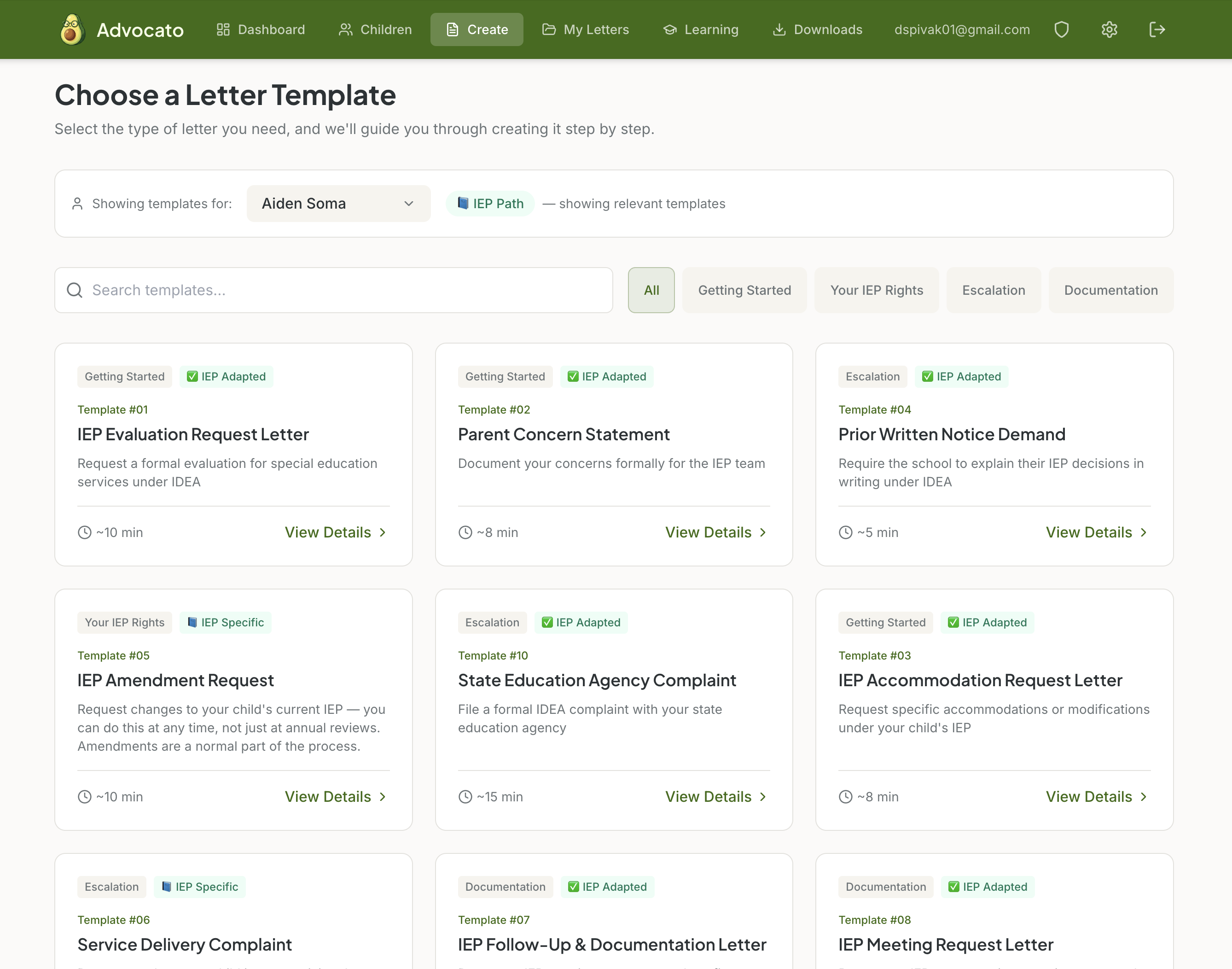
Browse letter guides

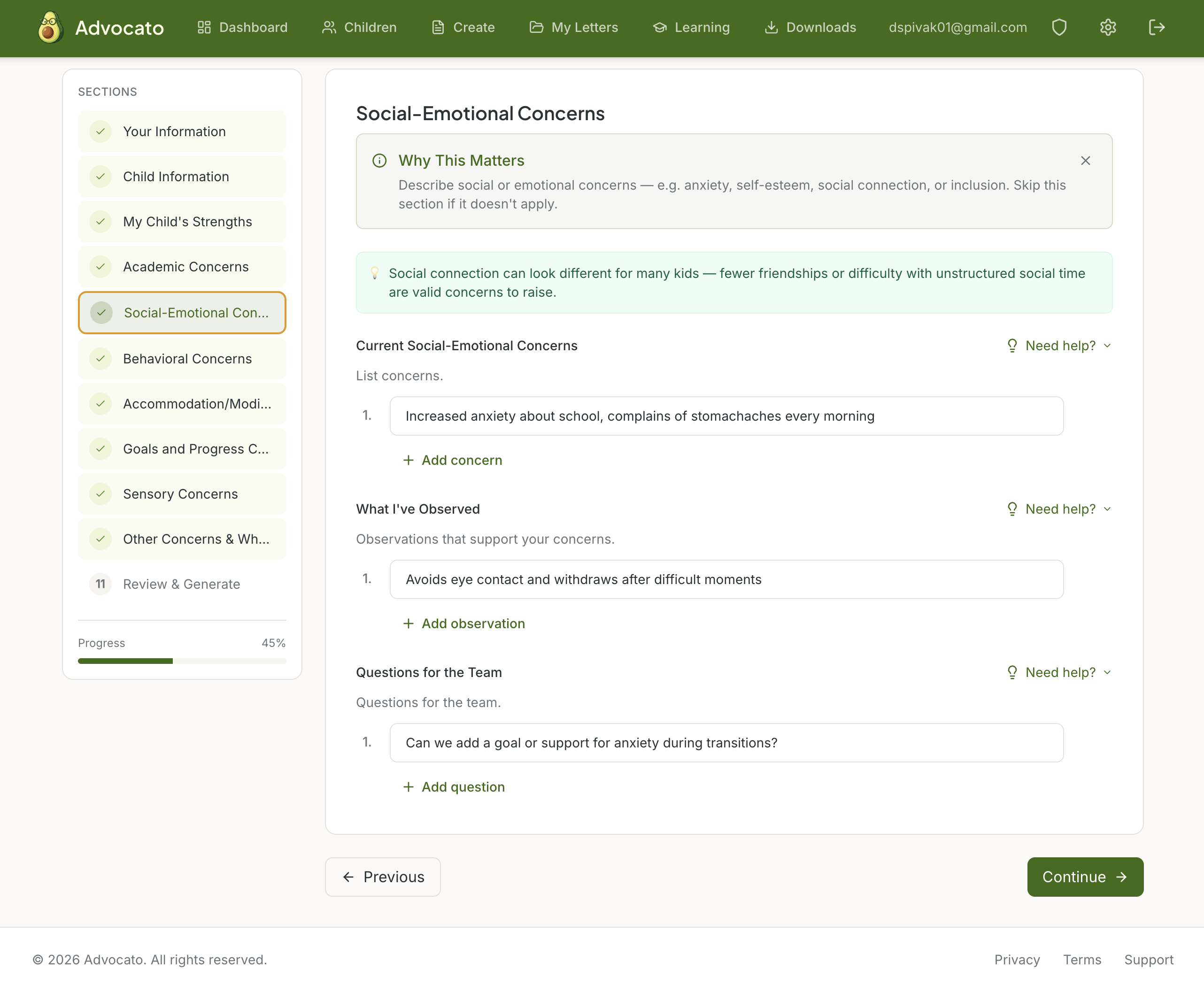
Answer questions. Get your letter. Use it.

A Real Platform, Not Blank Documents to Fill In

Log in anytime, create letters, watch training videos, and access your documents from any device.

Answer simple questions, get a professional letter
Guided Letter Library
Guided Letter Generator

Guided Letter Generator

Advocato IEP Letter Generator - Generate Professional Special Education Advocacy Letters

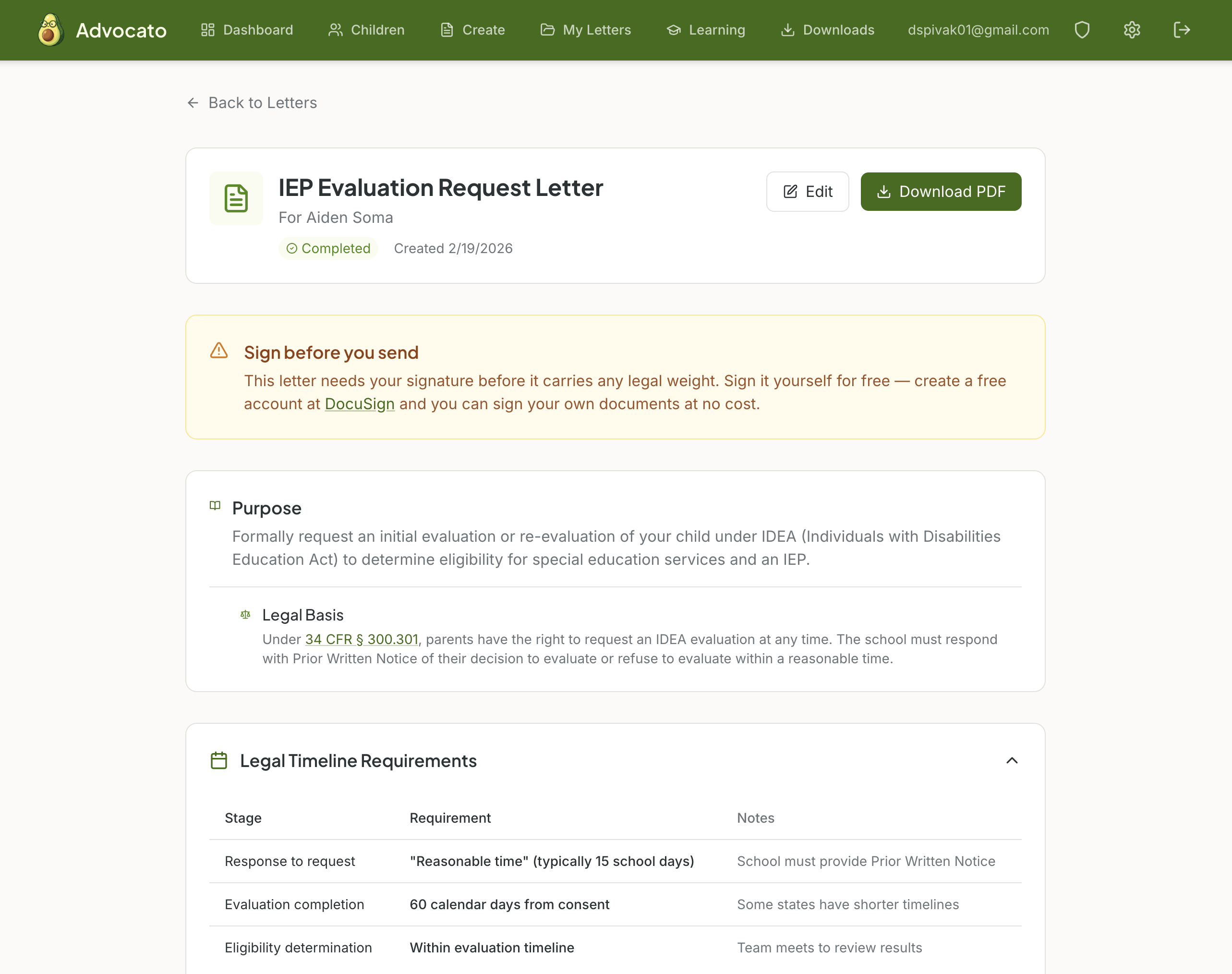
Letter Details

Letter Details

Get detailed info about all your letters

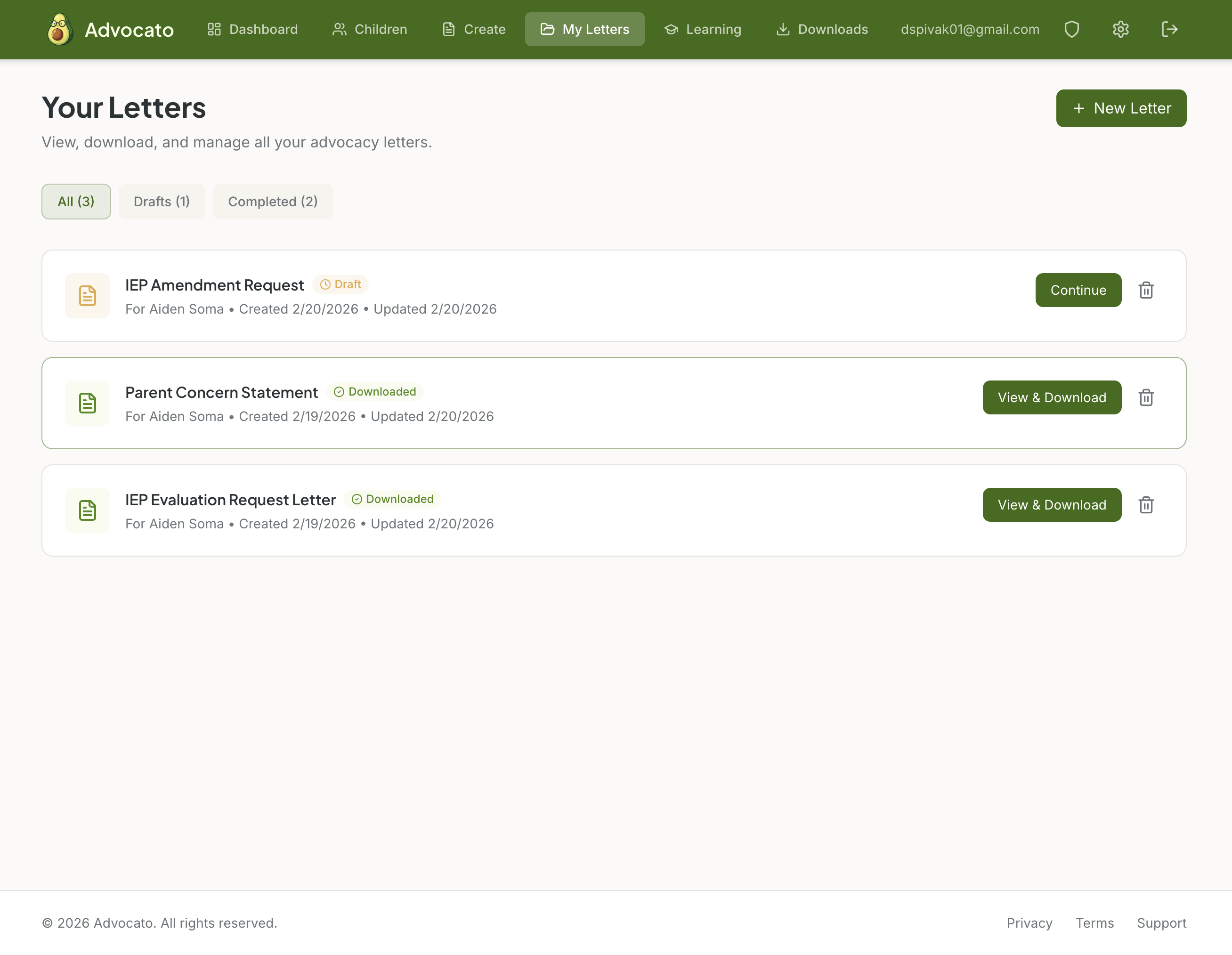
Your Letter Dashboard

Your Letter Dashboard

Access all your documents anytime

How It Works

Start with a free preview. See how it works. Then unlock everything.

1

Tell Me About Your Child

Start with our guided letter generator. No blank page, no guessing. Answer a few questions about your child's situation and I'll turn your concerns into a professional letter.

2

Watch Your Concerns Become a Letter

See how your real-life situation translates into the kind of professional language that schools take seriously and respond to. You'll feel the difference immediately.

3

Keep Everything, Forever

Love what you see? Get lifetime access to all 19 letter types, the complete video training library, and escalation guides for $197. One time.

GOT QUESTIONS?

Frequently Asked Questions About IEP & 504 Advocacy

No, you do not need a medical diagnosis to request a school evaluation. Under IDEA, you have the legal right to request an evaluation in writing at any time, and the school must respond within their state's mandated timeline. School-based evaluations assess educational need, not medical conditions. For IEPs, your child may qualify under one of 13 IDEA eligibility categories (including 'Other Health Impairment' for ADHD and 'Autism'). For 504 plans, eligibility is even broader. Any condition that substantially limits a major life activity, including learning, concentrating, and reading, can qualify. Advocato walks you through exactly how to write the evaluation request letter with the right legal language.
An IEP (Individualized Education Program) is governed by IDEA and provides specialized instruction plus related services. It's a more comprehensive plan with legally binding goals and progress monitoring. A 504 plan is governed by Section 504 of the Rehabilitation Act and provides accommodations and modifications in the general education setting. The key difference is that IEPs require that a child needs specialized instruction, while 504 plans cover children who can learn in the general curriculum but need support to access it equally. Many children with ADHD, anxiety, or mild learning differences qualify for a 504 even if they don't meet IEP eligibility. Advocato helps you understand which plan fits your child and creates the right letters for either path.
First, don't accept a verbal denial. Under IDEA, you have the right to a Prior Written Notice (PWN) any time the school refuses to evaluate or provide services. This means they have to document their reasoning in writing, which creates accountability. Second, know that academic performance is only one factor in eligibility. Your child may qualify based on social-emotional needs, behavioral challenges, executive functioning, or other areas. Third, you can request an Independent Educational Evaluation (IEE) at the school's expense if you disagree with their assessment. Advocato includes letters for requesting PWN, challenging denials, and requesting IEEs, with the exact language that starts legal timelines.
An effective IEP evaluation request letter should include your child's full name and date of birth, the specific concerns you're observing at home and school, a clear written request for a comprehensive evaluation under IDEA, and a reference to your rights under your state's timeline requirements. The key is using language that creates a legal obligation. The word 'request' combined with 'evaluation under IDEA' starts the clock on the school's mandated response timeline. Advocato's guided letter generator walks you through each section, asks you the right questions about your child, and creates a professional letter with all the legally required elements. You can preview your first letter free.
Preparation is everything. Before the meeting, review your child's current IEP goals and progress reports, write down your top 3 concerns, and bring documentation of any issues like emails, behavior logs, and report cards. During the meeting, start by sharing what's working, then address your concerns with specific examples. Use phrases like 'I'd like that documented in the IEP' and 'I'd like Prior Written Notice if the team is declining that request.' These phrases show that you understand your rights. After the meeting, send a follow-up email summarizing what was discussed and agreed upon. Advocato includes IEP meeting preparation checklists and follow-up letters to help you stay organized and on track.
Yes, ADHD and anxiety are among the most common reasons children receive 504 plans. Under Section 504, a child qualifies if they have a physical or mental impairment that substantially limits one or more major life activities. For ADHD, this typically includes concentrating, learning, and executive functioning. For anxiety, this can include attending school, completing assignments, and participating in class. Common 504 accommodations include extended test time, preferential seating, movement breaks, reduced homework load, and check-ins with a counselor. You don't need a formal medical diagnosis to request a 504 evaluation, though having documentation from a doctor or therapist strengthens your case. Advocato helps you write the accommodation request letter and figure out which accommodations to ask for.
Prior Written Notice (PWN) is a legal document that schools must provide whenever they propose or refuse to change your child's identification, evaluation, placement, or services. It's one of the most powerful tools in a parent's advocacy toolkit because it requires the school to put their decisions and their reasoning in writing. Many parents don't know they can request PWN, which means schools often make verbal decisions without any documentation. When you say 'I'd like Prior Written Notice of that decision,' you're creating a paper trail that holds the school accountable. If you ever need to file a state complaint or due process request, the PWN becomes critical evidence. Advocato includes a Prior Written Notice request letter that uses the exact language required under IDEA.
Under IDEA (Individuals with Disabilities Education Act), parents have extensive rights known as Procedural Safeguards. These include the right to request an evaluation at any time, the right to participate in all meetings about your child's education, the right to access all educational records, the right to receive Prior Written Notice of any changes, the right to an Independent Educational Evaluation (IEE) if you disagree with the school's evaluation, the right to dispute resolution through mediation or due process, and the right to stay-put, meaning your child's current services continue during any dispute. These rights exist at the federal level and apply in every state. Advocato's video training course walks you through each one in plain language, and our guided letter generator helps you put these rights into action.
Advocato is a one-time payment of $197 with lifetime access. No subscription, just one price. This includes the complete video training course on IEP and 504 advocacy, the guided letter generator for all 19 letter types, state-specific timelines and resources, and ongoing platform updates. You can start with a 7-day free trial before committing. Compared to hiring a special education advocate ($2,000 to $5,000+) or an attorney ($300 to $500/hour), Advocato gives you professional-quality tools at a fraction of the cost.
Yes and no. The core advocacy strategies and letter formats are based on federal IDEA law, which applies in all 50 states. This means the fundamental rights, evaluation processes, and procedural safeguards work nationwide. However, each state has specific timelines (for example, how many days a school has to respond to an evaluation request) and some states have additional protections beyond federal requirements. Advocato includes state-specific timeline information built right into your letters, so the deadlines referenced in your correspondence are accurate for your location. The platform works for families in any state.

Have another question? Contact us

PARENT RESOURCE

The Parent's Guide to IEP & 504 Advocacy

Everything you need to know about special education rights, evaluation processes, and effective advocacy, all in one place.

What Is an IEP and Who Qualifies?

An Individualized Education Program (IEP) is a legally binding document created under the Individuals with Disabilities Education Act (IDEA). It outlines the specialized instruction, related services, accommodations, and measurable goals your child will receive in school. Unlike a 504 plan, an IEP provides a comprehensive framework for children who need more than general classroom accommodations to make progress.

Under IDEA Section 300.8, your child may qualify for an IEP if they have a disability that falls into one of 13 eligibility categories, including Specific Learning Disability, Other Health Impairment (which covers ADHD), Autism, Emotional Disturbance, and Speech/Language Impairment, and that disability adversely affects their educational performance. Importantly, "educational performance" isn't limited to grades. It also includes social skills, behavior, executive functioning, and emotional regulation.

The IEP Evaluation Process

The process starts when you submit a written evaluation request to your school district. This triggers a legal timeline. In most states, the school has 60 days to complete the evaluation, though timelines vary by state. The school cannot refuse to evaluate without providing Prior Written Notice explaining their reasoning. The evaluation is conducted at no cost to you and must assess all areas of suspected disability.

After the evaluation, an IEP team meeting is held to determine eligibility and, if your child qualifies, to develop the IEP. You are an equal member of this team. Your input on goals, services, and accommodations matters. The IEP must be reviewed at least annually, and your child must be re-evaluated at least every three years.

Your Rights Under IDEA

IDEA guarantees parents strong procedural safeguards, including the right to participate in all decisions about your child's education, the right to review all records, the right to receive Prior Written Notice, the right to an Independent Educational Evaluation (IEE) if you disagree with the school's findings, and the right to dispute resolution through mediation or due process. These protections exist because Congress recognized that parents are the most important advocates for their children.

Advocato gives you the tools and knowledge to navigate the IEP process with confidence. Start your free trial (one-time price after, no subscription).

What Is a 504 Plan?

A 504 plan is a formal plan developed under Section 504 of the Rehabilitation Act of 1973, a federal civil rights law that prohibits disability discrimination in any program receiving federal funding, including public schools. Unlike an IEP, a 504 plan does not provide specialized instruction. Instead, it ensures your child receives the accommodations needed to access the general education curriculum on an equal basis with their peers.

A child qualifies for a 504 plan if they have a physical impairment or mental health condition that substantially limits one or more major life activities, including learning, reading, concentrating, thinking, communicating, and social interaction. This standard is broader than IEP eligibility, which is why many children who don't qualify for an IEP can still receive meaningful support through a 504 plan.

IEP vs. 504: Which Does Your Child Need?

The key distinction is that an IEP is for children who need specialized instruction to make progress, while a 504 plan is for children who can succeed in the general curriculum with the right supports. If your child has ADHD and needs help with focus but doesn't require a different teaching approach, they likely benefit from a 504 plan with accommodations like extended time, preferential seating, and movement breaks. If your child has a learning disability that requires a different instructional method, they likely need an IEP.

504 Plans for ADHD and Anxiety

ADHD and anxiety are among the most common conditions supported by 504 plans. For ADHD, typical accommodations include extended test time, reduced homework volume, check-ins for task initiation, graphic organizers, and movement breaks. For anxiety, accommodations might include a quiet testing environment, flexible deadlines, permission to visit the counselor, modified presentation requirements, and a safety plan for high-anxiety days. You don't need a formal medical diagnosis to request a 504 evaluation, though documentation from a healthcare provider strengthens your request.

Advocato helps you secure the right 504 accommodations for your child. Start your free trial (one-time price after, no subscription).

Why Written Communication Matters in Special Education

In special education advocacy, verbal requests can be brushed aside. Written requests create legal obligations. When you put your concerns and requests in writing, you start the clock on federally mandated timelines, create a documented record of communication, and show the school district that you understand your rights. Schools respond differently to parents who communicate in writing with clear legal language. It's the single most powerful advocacy skill you can build.

Types of Advocacy Letters Every Parent Should Know

Evaluation Request Letter: The starting point for getting your child assessed. References IDEA and triggers the school's evaluation timeline. Must include specific concerns about your child's educational performance.

Parent Concern Statement: A formal record of your concerns about your child's progress, behavior, or well-being at school. This becomes part of the educational record and must be considered at IEP meetings.

Accommodation Request Letter: Used to request specific accommodations or modifications, either as part of a new 504 plan or as additions to an existing IEP or 504. Should reference the specific areas where your child needs support.

Prior Written Notice Request: When the school refuses a request verbally, this letter requires them to put their denial and reasoning in writing. It's one of the most underused and most powerful parent tools.

How Advocato's Letter Generator Works

Advocato's guided letter generator asks you simple questions about your child and your situation, then creates a professional letter with the correct legal language, proper formatting, and state-specific timeline references. No legal expertise required. You answer the questions, review the letter, customize as needed, and send. Each letter type includes built-in guidance explaining why each section matters and what the school is legally required to do in response.

Advocato helps you write professional advocacy letters in minutes. Start your free trial (one-time price after, no subscription).

Common School Denial Tactics

Schools deny services for many reasons: budget constraints, staffing shortages, or a genuine (if sometimes incorrect) belief that a child doesn't qualify. Common denial language includes "Your child is doing fine academically," "We'll try some classroom interventions first," "Your child doesn't have a diagnosis," and "Let's wait and see." Each of these has a specific, effective response grounded in federal law. Knowing those responses changes the conversation entirely.

Your Escalation Options

Prior Written Notice (PWN): Your first step after any denial. Request it in writing. The school must explain what they're refusing, why, what data they used, what alternatives they considered, and your rights. This alone often reverses decisions because documenting a weak rationale is uncomfortable.

State Complaint: You can file a complaint with your state's Department of Education alleging that the school violated IDEA. The state must investigate and issue a decision within 60 days. This is free, doesn't require a lawyer, and is often very effective for procedural violations (missed timelines, failure to provide PWN, not following the IEP).

Due Process: A more formal legal proceeding, essentially a hearing before an impartial officer. This is the strongest enforcement mechanism under IDEA. While you can represent yourself, many families hire an advocate or attorney for due process. The mere filing of a due process request often prompts the school to negotiate.

How to Document Everything

Documentation is your most powerful tool. Keep a communication log noting every phone call, email, and meeting: who said what, when, and what was decided. Save all written correspondence. After verbal conversations, send a follow-up email along the lines of "Per our conversation today, I understand that [summary of what was discussed]." Request copies of all evaluations, progress reports, and IEP/504 documents. If you ever need to file a complaint or due process request, this documentation becomes your evidence. Advocato's guided letter generator makes follow-up and documentation letters simple and consistent.

Advocato helps you challenge denials and protect your child's rights. Start your free trial (one-time price after, no subscription).

Artie the Advocato mascot

"Your child deserves the right support. And you deserve to stop feeling like you're on your own figuring that out."

— Artie

$397SAVE $200
$197

One-Time Payment • Lifetime Access

Everything Included:

  • Complete IEP & 504 Video Course
  • Step-by-Step Letter Guides
  • 19 Professional Advocacy Letters
  • Guided Letter Generator
  • Power Phrases Cheat Sheet
  • IEP Meeting Prep Checklist
  • "When They Say No" Escalation Guide
  • Lifetime Platform Access

No subscription. One-time payment for lifetime access after your trial.

Secure CheckoutInstant Access

Try Before You Commit: 7 Days Free

Try the letter generator with 3 letter types, watch Module 1 videos, and create up to 2 downloadable letters during your trial. Cancel anytime during the trial.